The London issue
London's Brutalist Utopias on Foot
A walking route through the city's post-war concrete, from the Barbican highwalks to a lake in Thamesmead, with what each stop costs and when to turn up.

By Rowan KelleherThe slow way round a fast city

Rain suits this concrete better than sunshine does. Wet, the Barbican's hand-hammered towers go the colour of a storm cloud, water runs in dark seams down every board mark, and the highwalks empty out until it is just you and the sound of your own shoes on a raised deck three storeys above the traffic. What follows is a walking route through the London that was built to be braver than the one it replaced: schemes that spent forty years being called a mistake and are now being listed, one by one.
Start at Golden Lane, not at the Barbican
Everybody begins at the Barbican and it is the wrong order. Walk first to Golden Lane Estate (Golden Lane, on the northern rim of the City), the smaller, earlier, considerably cheerier scheme by Chamberlin, Powell and Bon, and the one that won them the Barbican commission next door. It is lower, greener and far easier to read than its famous sibling: courtyards you can see straight across, colour on the panels, a scale that still feels like somewhere people hang washing. Which they do, because it is somebody's home. The walkways and courtyards are public routes, free, open at any hour and fine for a group of any size, but keep to those routes, keep your voice down, and never point a lens into a window.
Golden Lane Sport & Fitness (in the middle of the estate) is the piece almost every visitor walks past. It is a Grade II listed leisure centre still doing its original job, with a public pool and gym open to anyone on a day pass of around £10. Swimming lengths inside a listed post-war building for the price of a sandwich is the most Golden Lane thing you can do, and it costs you forty minutes.
From the estate's north-east corner, cross Goswell Road, pick up Fann Street, and the ground starts to lift.
Plan your London trip
Live prices from our booking partners.
Free cancellation on many rooms. We may earn a commission when you book.
See the Barbican while it is still the original
Barbican Centre and Barbican Estate (City of London) is the correct anchor for any concrete walk in this city and the most generous stop on the route. The estate, the highwalks, the lakeside terrace and the foyers cost nothing, need no booking, and absorb a group without anybody minding. Give it two hours and get deliberately lost, which is the building working as intended. There is a painted line on the ground to steer you in from the Underground station if you need rescuing.

The Conservatory, a tropical glasshouse sitting on top of the theatre's fly tower, is also free, but it runs on timed slots released online a month ahead with a small batch of same-day tickets from 9.30am. Slots go fast and every person needs their own, so book the day they drop rather than turning up hopeful. A party of six will not be walked in on goodwill. Gallery exhibitions are around £18 and group rates exist if you ask.
There is also a deadline, and it is the honest reason to make this trip in 2026 rather than someday. The Centre closes from the end of June 2028 until summer 2029 for a £240m renewal. This year and next are the last two in which you can see the foyers and the Conservatory in their original state.
One mile of the South Bank behaves like a single building
It is about thirty minutes on foot from the Barbican down to the river and west along the south bank, or twenty minutes underground with one change. Start upstream and work east, because that is the order in which the buildings argue with each other.

Southbank Centre (South Bank), meaning the Hayward Gallery, Queen Elizabeth Hall, Purcell Room and the walkways that stitch them together, was granted Grade II listed status in February 2026, which ends a very long argument in the buildings' favour. The whole site is public and free to walk through in any size group; Hayward exhibitions run around £18 with group rates. Underneath it, the Undercroft is open access, free, at all hours, and 2026 marks fifty years of unbroken skateboarding there, celebrated as Skate 50. Watch from the edge rather than the run-up, and ask before you film anyone. The Queen Elizabeth Hall roof garden is free and opens seasonally, and it is the calmest place on the whole river.

East under Waterloo Bridge, BFI Southbank (South Bank) is built into the raw concrete of the bridge itself and is the most usable stop on the route: a bar, the Riverfront restaurant, and free Mediatheque booths where you can sit and watch archive film for nothing. Walk in for the bar and the booths; book ahead for screenings, around £15, and for the restaurant if there are more than four of you, with mains roughly £14 to £25. Private hire runs through Benugo.
Two minutes further on is the National Theatre (South Bank), Denys Lasdun's 1976 building and the one that teaches you to look properly. The foyers, terraces and bars are free, open and unbooked, and you can sit there all afternoon with a coffee and nobody will move you on. The guided Architecture Tour, roughly £16 to £30, takes limited numbers and is the best-value hour on this list: it is where you learn that the board-marked concrete, with the grain of the shuttering timber still legible in it, was a deliberate idea and not a budget compromise. Groups must book, and so should couples in summer. There is also a Concrete and Cocktails tour that pairs the building with a drink, which is the right call at dusk when the terraces light up.

Bloomsbury holds one architect's whole career

The Brunswick Centre (Bloomsbury, directly opposite Russell Square tube) is Patrick Hodgkinson's Grade II listed 1972 megastructure and the most practical stop in central London: fully public, free, open all day, no booking, with cafés from around £5, a large Waitrose and the Curzon Bloomsbury cinema on site. Stand in the central deck and look up at the stepped terraces climbing away on both sides. It is also, unglamorously, where a walking group finds lunch and a toilet.

A few minutes south-west, 20 Bedford Way (Bloomsbury) is Lasdun's Grade II* university building, finished in 1977. It is a working faculty, so casual wandering inside is limited, but it trades commercially as an events, conference and filming venue with several halls, and takes group bookings on enquiry. The exterior is free to study from the street, and it opens properly during the Open House Festival each September.
Walk twenty-five minutes north-west, or take the tube to Great Portland Street, and you reach the Royal College of Physicians (Regent's Park), Lasdun's 1964 building and Grade I listed, a grade almost unheard of for post-war work. The museum, library and medicinal garden are free with no ticket for a general visit, which makes this the only place on the route where you can walk into a masterpiece for nothing and see the interior as designed. Expert-led architecture tours and group visits are arranged in advance, and opening depends on college events, so check before you set out. Stand back on the terrace edge afterwards: the white geometry against the cream Nash terraces beside it is the entire point of the building.

Where the concrete put on a suit
Not all of this was housing and culture. Space House (Holborn) is Richard Seifert's 1968 circular tower, reopened in 2024 after a four-year restoration and named the coolest new office development of the year by the Twentieth Century Society. The offices are private and let to commercial tenants, so the ground-floor lobby and café are the only interior most people see, but the new landscaped public realm at its base is free and open, and it occasionally takes part in Open House.

Walk down to St James's for Smithson Plaza (St James's), which most guidebooks still call the Economist Building. Tishman Speyer renamed it in 2016 for its architects Alison and Peter Smithson, so use the current name if you are asking directions. Their 1964 scheme invented the idea of handing a chunk of a commercial site back to the street as public space, and the raised plaza still works exactly that way: free, open, with a café at plaza level and a rotating free public art programme. Come on a weekday when office workers are using it, because the place only shows what it does when it is in use.

Goldfinger's two towers and the house he built for himself
Ernő Goldfinger's buildings need the most care from visitors, because two of the three are people's homes and nothing else.
Balfron Tower (Poplar, east London) came first, in 1967. It was the prototype, and Goldfinger tested it by moving into flat 130 for two months to live with his own design. It was refurbished and re-let as private homes in 2023, six flats kept as heritage interiors true to the original. There is no public access. The streets around it are open to any size of group and that is where you look from.


Trellick Tower (North Kensington, west London) is the 1972 refinement, Grade II* listed since 1998, and the listing is precisely why its hammered concrete has never been clad and covered over. It has 217 occupied flats, no lobby to enter and no visitor offer of any kind. Gather on the surrounding streets or the canal towpath, which gives the best view of the service tower and its walkways. It occasionally opens for guided visits during the September Open House Festival; book the moment listings go live, because those places vanish in a day.
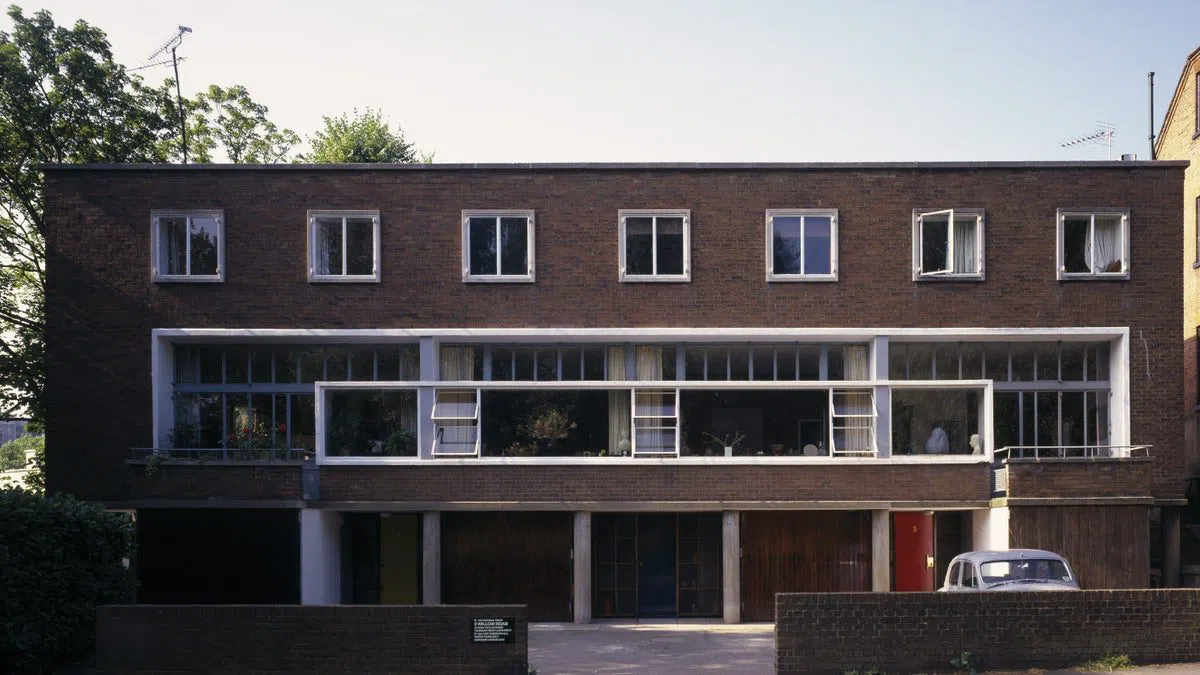
The counterweight is 2 Willow Road (Hampstead), the house Goldfinger built for himself and his family in 1939, now National Trust, and it undoes every lazy assumption about the man who designed those towers. It opens Thursdays and Saturdays from March to October, pre-booked only, with hour-long guided tours at 11am, 12pm, 1pm and 2pm and self-guided entry from 3pm until it closes at 4.30pm. Entry is around £12 to £14, free to members. Places are strictly limited, so a large group will not fit on one tour; split across slots or contact the property in advance. It is shut from November to February, so do not route a winter trip through it.
The Overground links Hampstead Heath to Kensal Rise, and it is a short walk from there down to Golborne Road, which makes Willow Road and Trellick a sane single afternoon. Balfron sits on the other side of the city and pairs better with the trip east below.
The estate that settles the argument
Alexandra Road Estate (South Hampstead), also called Alexandra and Ainsworth, is Neave Brown's 1978 Grade II* scheme and the strongest evidence in London that this kind of social housing worked. Walk the central pedestrian street early on a weekday, when it is nearly empty. The long terraces step back as they rise, no car ever touches the street, and the tall northern block takes the noise of the railway behind it so the whole place stays oddly hushed. The park alongside is separately listed, which is vanishingly rare for a post-war estate landscape.

The street and the park are public rights of way, free, open at any time and fine for a walking group. The rules are the same as at Golden Lane, and they matter more here because visitors arrive constantly: stay on the street, keep the noise down, no photographing into homes.
The far edge at Thamesmead
Thamesmead is the utopian new town that got filmed for A Clockwork Orange and then spent decades being used as shorthand for failure. Going there is a half-day round trip, the Elizabeth line to Abbey Wood and then a bus or a walk of twenty-odd minutes, and it is worth it for one address.
Lakeside Centre (Thamesmead, south-east London) sits on the edge of Southmere Lake, a £2.7m refurbishment run by Bow Arts, and it is the only place out there that gives a visitor a reason to sit down. Entry is free. There is a café at around £5 to £10, a community garden and 38 artist studios, with open studio events through the year. Email ahead if there are more than a few of you and a studio visit can usually be arranged. Do this stop with your camera in your bag and talk to people who actually live with the concrete. It is the correction to everything the film taught you.
Whether to walk it alone or take a guide
Everything above can be walked unguided and most of it costs nothing. But estates are places where visitors get things wrong, and if you want the buildings explained by someone who knows them rather than drifting awkwardly around strangers' front doors, Open City (the architecture charity behind Open House) runs scheduled shared walks year-round at roughly £20 to £30 per person, with fixed small-group capacity. Their Golden Lane and Barbican walk is the flagship. Private group tours are booked directly and quoted on request, which is the better route for anything above eight people. Couples and pairs slot into the scheduled walks easily.

If your dates are movable at all, come in September. Open City runs the free Open House Festival then, and it is the one time of year several private buildings on this list open their doors.
Practical notes
Tap in and out with a contactless card or phone; the daily cap makes a day of this cheap however many times you move. The clusters are walkable inside themselves, with Golden Lane to the Barbican five minutes and the whole South Bank stretch fifteen, and it is only the towers and Thamesmead that need real journeys.
Cards work everywhere on this route, including the pool day pass and the Lakeside café, so you need no cash at all. Prices here are in pounds sterling.
Do the estates in the morning on a weekday, when they are quiet and you are least intrusive. Save the culture buildings for the afternoon and early evening, when the foyers fill and the terraces come alive. Book the Barbican Conservatory a month out, the National Theatre tour a week out, and 2 Willow Road as soon as you have dates, remembering it only opens Thursdays and Saturdays, March to October.
Two thirds of this walk is free. A full day with one exhibition at around £18, a National Theatre tour at £16 to £30 and lunch at the Brunswick lands somewhere between £40 and £70 a head. Strip the tickets out and it costs a sandwich.
Base yourself in the City or on the South Bank and you can start walking from the door. Compare rates with the London hotel search, and for everything else in the city, the London guide covers the rest.
Wear shoes you can do twelve kilometres in, and hope for rain.
Before you go
Can you go inside the Barbican for free?
Yes. The estate, highwalks, lakeside terrace and foyers are free, open to anyone including groups, and need no booking. The Conservatory is also free but requires a timed slot booked online, released a month ahead with limited same-day tickets from 9.30am. Only the gallery exhibitions are ticketed, at around £18 with group rates.
Can you visit Trellick Tower or Balfron Tower inside?
No. Both are private residential buildings. Trellick has 217 occupied flats and no public lobby, and Balfron was refurbished and re-let as private homes in 2023. View them from the surrounding streets and, at Trellick, the canal towpath. Trellick occasionally opens for guided visits during the Open House Festival each September; book the moment listings go live.
How much of this walk can you do in one day?
Realistically one cluster plus one outlier. Golden Lane, the Barbican, Bloomsbury and the South Bank chain together into a single full day on foot. The Goldfinger towers, Alexandra Road and Thamesmead each need their own journey, and Thamesmead alone is a half-day round trip via Abbey Wood.
Is it acceptable to photograph the housing estates?
Photograph the architecture from the public routes, never into anyone's windows or interiors. Golden Lane and Alexandra Road are working homes with public rights of way running through them, so stay on those routes, keep the noise down, and if you are in a group, spread out rather than blocking a walkway.
When is the best time of year to make this trip?
September, for the free Open House Festival run by Open City, when private buildings on this route open to visitors. Otherwise March to October, so 2 Willow Road is open: it closes November to February. And before the end of June 2028, when the Barbican Centre shuts until summer 2029 for its £240m renewal.


